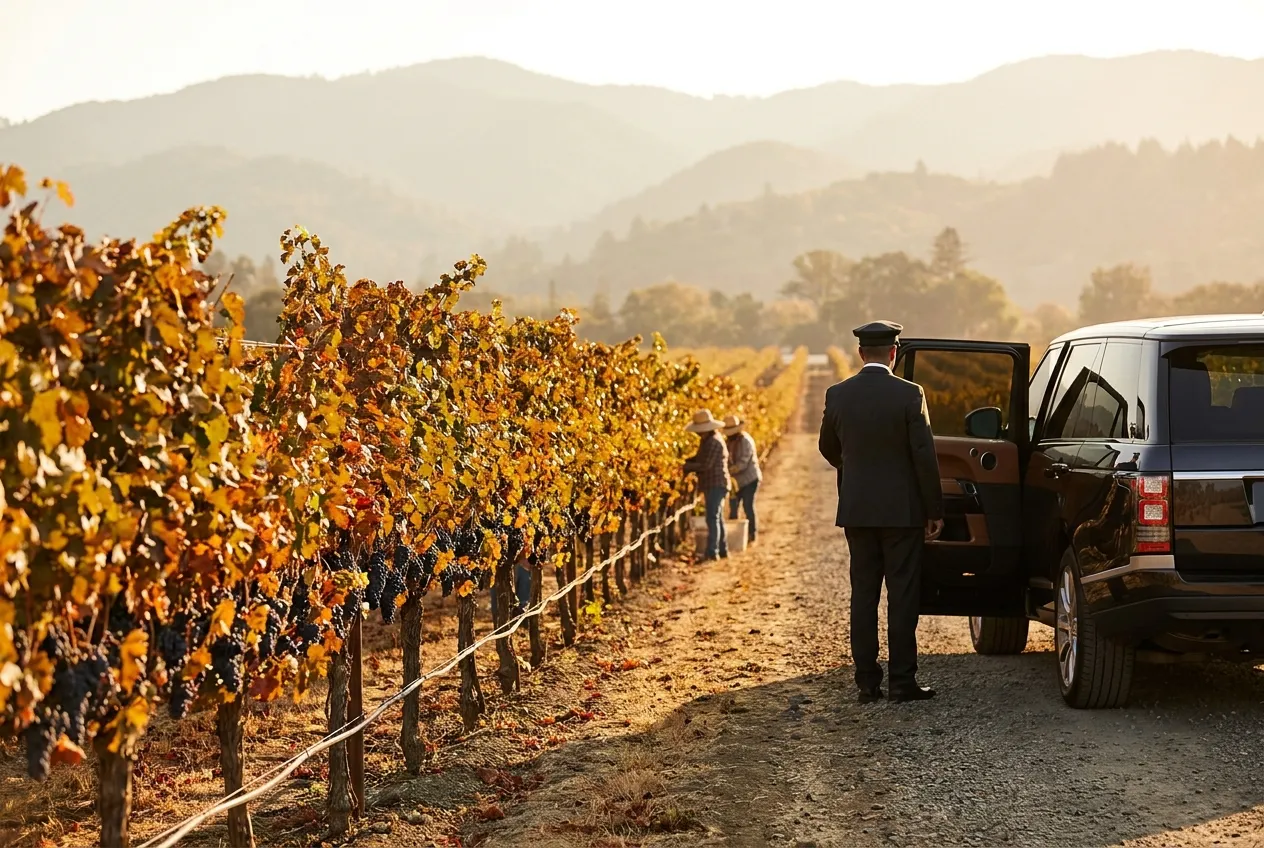
Overview: why harvest season changes the ground plan
Harvest in Napa Valley is the late-summer to autumn period, roughly August through October, when demand for wine-country travel rises. Timing shifts every year with weather and grape variety, so this guide deliberately avoids specific dates. It adds planning context around our Napa wine tour chauffeur page for executive assistants, retreat planners and private travelers.
Why it matters:
- Demand for drivers, vehicles and tasting appointments tends to rise, so late requests are harder to accommodate.
- The valley is long and narrow, with a small number of main corridors, so a delay at one stop can carry through the rest of the day.
- Each venue sets its own schedule and policies, and these can change. Confirm them directly.
Harvest season at a glance
Think of harvest as a broad window, not a fixed calendar. Current information on the season and on member wineries is published by Napa Valley Vintners and Visit Napa Valley. We do not publish harvest, crush, event or festival dates here, and we cannot promise winery availability for any particular week.
For county-level information, start with the County of Napa. For live highway conditions on the day of travel, the Caltrans QuickMap is the official tool. Road closures and traffic are not predictable in advance, so we make no claims about them.
Key routes and airports
Most wine-country days run along two main north-south corridors, Highway 29 and the Silverado Trail, with Carneros at the southern end of the valley. Which one a driver uses at a given moment depends on conditions, so ask your operator how they plan to sequence stops rather than assuming a fixed route.
The route cards attached to this article link to Google Maps directions from the main arrival airports. We have not published distances or drive times because we have not tied them to an official source. Check live conditions before departure.
Arriving by air
San Francisco International (SFO) is the most common gateway for international and long-haul guests. Our SFO to Napa transfer page covers the route. For terminal and arrival information, see flysfo.com.
Oakland (OAK) is often considered when flight schedules or East Bay origins favor it. See our Oakland airport hub for details.
San Jose (SJC) suits Silicon Valley travelers who are continuing to wine country. Our San Jose airport hub has more.
Napa County Airport (APC) is a general aviation airport, relevant to private aircraft. Our Napa County Airport (APC) page covers it. Confirm handling arrangements with your FBO or flight department.
Sonoma County Airport (STS) can be a practical northern gateway, especially for itineraries centered on upper valley towns or Sonoma. See Sonoma County Airport (STS).
Sacramento (SMF) is an option for travelers coming from the east or for itineraries that include the Sacramento area. See Sacramento airport (SMF).
Tasting-day pacing
These are planning suggestions, not venue policies. Many planners find that two to three appointments is a comfortable day, and four is ambitious, especially during a busy season. Leave time for a proper meal break rather than relying on tasting-room snacks, and keep water in the vehicle for every guest.
Reservation windows, group-size limits, arrival tolerances and cancellation terms differ by venue and are not announced centrally. Ask each venue directly what it requires, and share confirmed appointment times with your chauffeur so the day's sequence reflects real travel time between stops.
Where to go: places worth planning around
This is geography and planning context only. We make no availability claims about any winery.
- City of Napa: the southern hub of the valley, with the widest range of lodging and dining. It often works as a base or a first and last stop.
- Yountville: a compact town north of Napa. Confirm dining reservations early, since planners often center an evening around it.
- St. Helena: a central valley town. It is a convenient midpoint for groups who want to reach both the southern and northern ends without long repositioning.
- Calistoga: the northern end of the valley. Allow extra time when it is paired with a southern airport arrival or departure.
- Highway 29 and Silverado Trail: the two main corridors. Group stops on opposite sides of the valley may need crossovers, so sequence appointments by area rather than by preference.
- Carneros: the southern, closest-to-the-bay end of the valley. It can suit a first or last appointment on arrival or departure days.
- Sonoma: an alternative day outside Napa County. It is worth considering when Napa appointments are limited, but it adds its own travel time.
Booking lead time and buffers
We recommend requesting service as soon as your itinerary is reasonably firm. As a planning rule, aim for at least two weeks ahead for individual transfers and four weeks or more for groups, multi-vehicle programs or retreats. These are recommendations, not availability promises, and the operator has to confirm vehicles and drivers for your specific dates.
Late notice is riskier in harvest season because demand and tasting appointments are both tighter. Build buffers around flight arrivals (customs, baggage, delays) and between appointments. When you are ready, you can request a quote with flight numbers, party size and the appointments you have confirmed.
Group coordination
Confirm the final party size, luggage and any accessibility needs before choosing a vehicle. Larger parties may use an Executive Sprinter instead of splitting across several cars, which keeps the group together between stops. Vehicle assignments are confirmed by the operator, so ask rather than assume. Our group transportation page outlines the options.
For corporate programs, a single point of contact on each side helps. Retreats that combine airport pickups, a tasting day, a dinner and a return transfer benefit from one written schedule, which you can build with our executive retreats team. For roadshows or multi-stop days that include Silicon Valley or San Francisco, state each stop and its time window up front.
Return transfers
Plan return legs as carefully as arrivals. Work backward from the departure time, and keep a generous buffer between your last evening commitment and the airport departure window. Evening departures should allow for dinner running long, and the buffer should be larger than you would use for a daytime trip.
When a group has different flights, consider splitting returns by airport or departure time, with a separate vehicle for earlier flights rather than holding everyone to the earliest one. Share flight numbers with the operator so they can monitor status.
Contingency planning
- Closure fallback: check Caltrans QuickMap on the day. Agree in advance with the operator how stops will be reordered or dropped if conditions change.
- Backup pickup zone: identify an alternate meeting point at each venue and at the hotel in case the primary one is congested or restricted.
- Weather: harvest-season conditions vary. Keep outerwear and water in the vehicle and be ready to move indoor appointments earlier if needed.
- Flexible time: if your schedule is uncertain, hourly as-directed service can give you room to adjust during the day.
Working with the venue, FBO or airport
Ask each venue about its arrival and parking arrangements, group limits, and any rules for vehicles and guest counts. For airports, check the official pages, such as flysfo.com, for current pickup arrangements, and confirm meeting points with your operator. If you are flying privately, confirm FBO handling, ground-access arrangements and ramp or curbside rules with the FBO directly. Because policies change, treat anything not confirmed in writing as unconfirmed. You can see the vehicles in our fleet before you decide.
Summary and FAQ
Harvest runs roughly August through October, with dates that vary each year. Confirm timing with Napa Valley Vintners and Visit Napa Valley, request chauffeur service early, and pace tasting days conservatively.
When is harvest in Napa Valley? Roughly late summer through autumn, August through October, but it varies with weather and grape variety. Check Napa Valley Vintners and Visit Napa Valley.
How many tastings should a group book in one day? Two to three is a common planning range. Confirm each venue's reservation requirements directly.
Which airport should we use? SFO, OAK, SJC, STS and SMF are all options for commercial travel, and APC handles general aviation. Choose based on flights and itinerary.
How far ahead should we book? We suggest at least two weeks for individual transfers and four or more for groups. Availability is confirmed by the operator.
Will roads be closed or congested? That cannot be known in advance. Check Caltrans QuickMap on the day and agree on a fallback plan with the operator.
Can we split a group's return trips? Yes, in many cases. Share each person's flight details with the operator in advance.